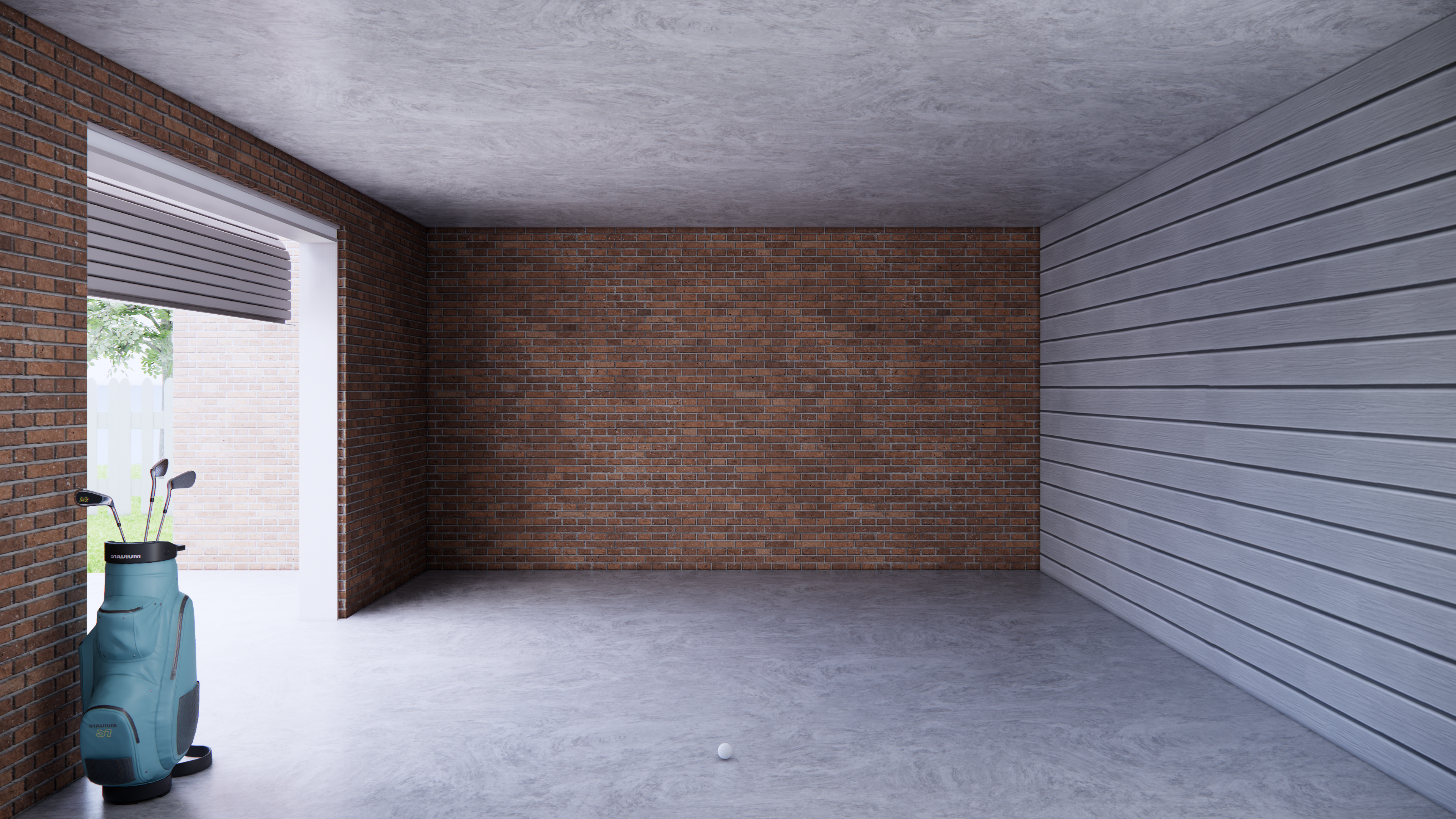
Garage Golf Simulator: The Complete Conversion Guide
A garage is one of the best spaces for a home simulator — if you know what to plan for. Here's everything we check on a garage install, from ceiling height to the door.
The garage advantage
A standard Irish double garage — roughly 5.5m wide × 6m deep — ticks most of the dimensional boxes straight away. Length is comfortable, width gives you proper centre-hit clearance, and the concrete floor is a solid base for the turf and hitting strip.
The things that need attention in most garages: ceiling height, insulation and heat retention, the door (which either stays useful or becomes a screen wall), and underfloor comfort. None of these are showstoppers, but plan them in before you start buying equipment.
Ceiling height in a garage
Most standard garages in Ireland have an internal height of 2.1m to 2.4m (7ft to 8ft) at the walls, rising to 2.7m–3m at the apex if there's a pitched roof. That's the range where it gets interesting.
The number you need is the height at the swing arc — above and slightly behind the hitting mat, not at the walls.
Flat ceiling at 2.4m or less — you have a decision to make: cut a recess into the ceiling above the swing area (we've done this several times, it works), or keep the setup to irons and shorter clubs only.
Apex at 2.8m–3m over the hitting position — viable for a full simulator. We position the hitting mat under the ridge so you get maximum height where it matters.
3m+ apex — ideal. Standard full-swing setup, no compromises.
See Golf Simulator Ceiling Height for a full breakdown of the options when a ceiling falls short.
Insulation, heating and condensation
A bare-block or single-skin garage is miserable to use in November. More to the point, temperature swings and condensation are bad for electronics — your projector, PC and launch monitor all prefer a stable environment.
Insulation should go on the walls and the roof/ceiling plane — not just the walls. Rigid foam board (PIR) is fast and effective; 75mm on the walls and 100mm overhead will transform a cold garage into a room you'll actually use in winter. Stud the walls over the insulation, board and skim — it's a tidy finish and gives you surfaces to mount screens and wall pads.
Heating. A single wall-mounted electric panel heater (1.5kW to 2kW) is plenty for a well-insulated garage bay. Set it to come on an hour before your planned session — you don't need it running all day. Underfloor heating is an option during a renovation, but electric panel is the practical choice for a retrofit.
Condensation. Even with insulation, a garage that goes from cold to warm and back will get moisture. A small dehumidifier running on a timer handles this. It's cheap, it protects the equipment, and it saves you worrying about it.
The garage door question
This is one of the first things we ask on a garage install. You have a few options:
Keep the door operational with a retractable screen Our favourite solution for garages where the door is still wanted — for a car, storage, or just to keep the space flexible. The GTS Ultra Stealth retractable screen rolls up to ceiling height when not in use. Pull it down and you have a full-size impact screen; roll it up and the garage door works as normal. It's a genuine 'best of both' setup, and one we've installed in several Dublin and Leinster garages. Lead time is typically 6–8 weeks as it's custom-made to your door opening.
Board the door opening and create a permanent wall If you're committing fully to the simulator and no longer need the door, board across the opening (insulate while you're at it), and you gain a solid back wall for screen mounting. Structurally simple and gives you the cleanest finish.
Leave the door in place and work around it Possible, but compromises the insulation and screen placement. We'd only suggest this if the simulator is a short-term test setup.
Flooring for a garage simulator
Concrete is cold, hard and unforgiving on your joints over a long session — and it's less than ideal for accurate launch monitor readings if you're setting up a mat on a wobbly surface.
A proper garage simulator floor layers up as follows:
1. Concrete levelling compound if needed — a perfectly flat base matters for hitting mat stability 2. Underlay — 10mm–15mm foam or rubber; takes the edge off the concrete and deadens impact noise 3. Putting turf — a quality artificial turf surface over the full hitting area 4. Hitting strip — a dedicated 400mm × 800mm hitting mat for shot feedback; this is what your club actually contacts
The whole setup sits on top of the concrete without bonding to it, which means it can be lifted if the garage ever changes use. Some customers add a rubber-backed stall mat under the turf in the hitting zone for extra cushioning — worthwhile if you're on a very hard slab.
For a longer discussion of flooring and the rest of the room, see Room Design & Dimensions.
A typical garage install, spec by spec
Here's roughly what a complete garage conversion looks like when we spec it out:
Screen: GTS Ultra Stealth retractable (if door is being kept) or fixed SQ enclosure
Launch monitor: Uneekor EYE XO (overhead) or SkyTrak+ (side-mount) — both work well in garage dimensions
Projector: Panasonic 6,000-lumen laser — short-throw, low maintenance, handles the ambient light that garages tend to pick up
PC: Dedicated gaming-spec machine running E6 Connect or GSPro
Flooring: Foam underlay + quality putting turf + 400mm × 800mm hitting strip
Wall/ceiling pads: Impact-rated foam panels protecting the side walls and ceiling plane behind the screen
Heating: 1.5kW panel heater on timer
Total installed cost for this kind of setup typically runs €12,000–€18,000 depending on the launch monitor you choose. A more modest garage setup with a SkyTrak and a fixed screen can come in around €9,000–€11,000.
For pricing by component, see Golf Simulator Pricing. For the full range of launch monitors, Golf Simulators.
Got a garage? Let's see what's possible.
Send us your garage dimensions — width × height (wall and apex) × depth — and we'll come back with a layout and a budget range. Or book a €50 consultation at our Dublin demo centre; it's fully redeemable against your order. Call 01 582 6935.
Or call us directly: 01 582 6935